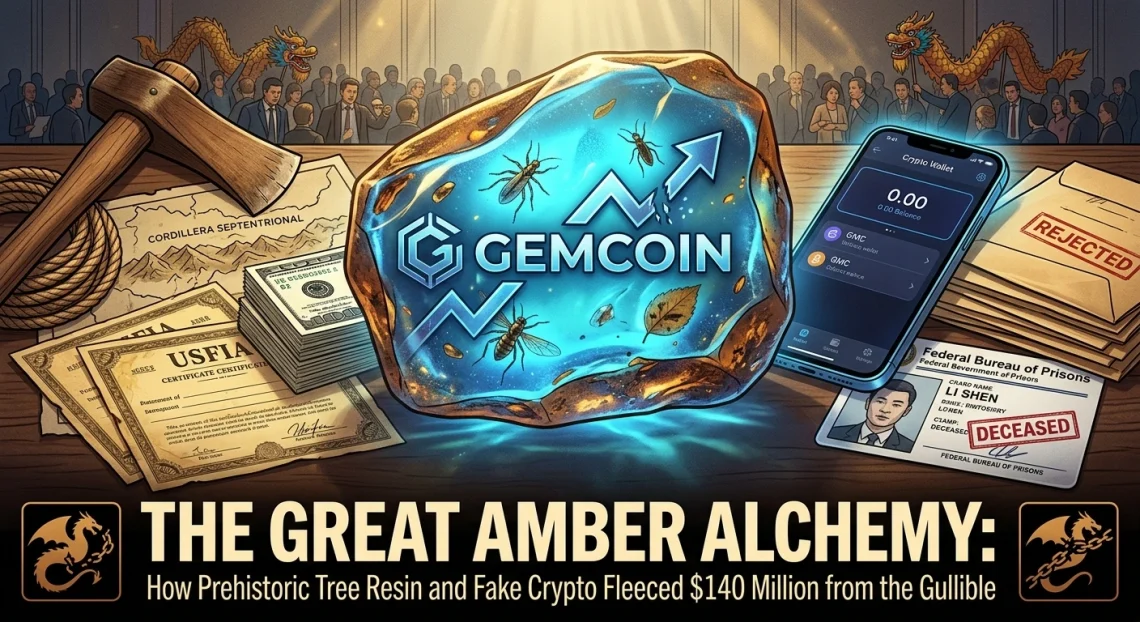
The Great Amber Alchemy: How Prehistoric Tree Resin and Fake Crypto Fleeced $140 Million from the Gullible
Based on Alec Corday’s video La ESTAFA mas grande que NO CONOCES! ¡USARON ÁMBAR DOMINICANO PARA ROBAR MILLONES!
Every grand financial swindle requires a compelling origin myth—preferably one that blends exotic geography, cutting-edge technology, and the irresistible promise of effortless wealth. A decade ago, a masterclass in economic theater managed to fuse prehistoric Dominican tree resin with digital financial magic, orchestrating a scam so preposterously engineered that it left a trail of bankrupt dreamers, disgraced politicians, and a ghost in a federal inmate database.
Long before crypto peddlers mapped out their Caribbean tax havens, Dominican amber already occupied a distinct tier in the global luxury trade. It is arguably the finest on Earth—so impeccably clear and rich with prehistoric inclusions that it famously served as the narrative prop for Jurassic Park. But within the trade, one anomaly sits at the absolute top: Dominican blue amber. Rare, hyper-sensitive to ultraviolet light, and glowing with an eerie azure luminescence under natural sunlight, it became an outright mania in East Asia between 2010 and 2015.
In Chinese market culture, status is rarely left to subtle abstraction; it is worn, displayed, and aggressively leveraged. Centuries of tradition dictating that fortune must be physically symbolized merged seamlessly with hyper-capitalism. Ancient lore claimed that when a tiger dies, its spirit plunges into the earth and crystallizes into amber—making the stone the ultimate emblem of raw power and residual luck. When speculators realized the world’s most elite amber was being clawed out of muddy, vertical hand-dug shafts in the northern mountains of Hispaniola, the influx of capital was swift and predatory.
Cash-flush buyers flooded Dominican mining villages, throwing exorbitant sums at local diggers and driving a speculative bubble that nearly broke the local market. Among these buyers was Steve Chen (born Li Shen)—a stone-faced operator who rarely smiled, wore sunglasses indoors, and possessed a resume littered with failed corporate shell games. Chen purchased hundreds of acres of Dominican land, loaded container ships with raw material, and sent them back to Asia.
There was just one catch: true blue amber is a geological fluke. The vast majority of what Chen purchased was ordinary, run-of-the-mill yellow resin. Beautiful, sure, but far from a fortune-making asset. Facing warehouses packed with mid-tier fossilized sap that couldn’t command top-dollar prices, Chen executed a pivot that was as cynical as it was brilliant.
He stopped trying to sell the amber on the open market. He used it as financial bait instead.
Enter US Fine Investment Arts Incorporated, or USFIA. Operating out of Arcadia, California—a wealthy L.A. enclave with a deep, affluent Asian immigrant demographic—USFIA offered a deceptively simple proposition. Mark investors handed over cash, ranging from $1,000 to $30,000, in exchange for “points” promised to convert into high-yield corporate stock once the firm went public. And to seal the psychological trap, every mark walked away with a physical piece of Dominican amber.
It wasn’t pitched as a retail purchase; it was marketed as a lucky talisman—a tangible guarantee that their investment wasn’t built on thin air, but anchored to a physical treasure. To accelerate the burn, USFIA attached a ruthless multi-level marketing structure: recruit your relatives, your neighbors, and your church group, and unlock luxury cars, paid tropical vacations, and fat commission checks.
For a time, the performance art worked flawlessly. Banquet halls were rented, dragon dancers were hired, and polished display cases filled with Dominican amber glistened under the spotlights. Local leadership fell right into line—even the mayor of Arcadia publicly praised Chen as a visionary commercial titan.
By 2014, as Bitcoin started making global headlines, Chen realized his target audience needed a high-tech narrative upgrade. “Points” felt dated. Cryptocurrency was the new frontier.
Chen unveiled Gemcoin. The sales pitch was delivered with pseudo-financial gravity: if fiat currency was backed by untrustworthy governments and old money was backed by gold, Gemcoin would be the world’s first digital asset backed by vast, unmined reserves of Dominican amber.
To anyone with even a baseline understanding of distributed ledger technology or monetary economics, the pitch was pure nonsense. The core value proposition of a cryptocurrency lies in cryptographic scarcity, decentralized protocols, and network consensus—not a pile of unprocessed tree sap sitting in a warehouse. But in 2014, crypto was an enigmatic black box to the average retail investor. The public knew only two things: it sounded like the future, and early adopters were getting outrageously rich. Greed effortlessly steamrolled due diligence.
USFIA fully integrated Gemcoin into its pyramid. They even installed sleek, custom-branded ATMs at their Southern California headquarters where marks could feed in greenbacks for digital tokens and back again—a carefully staged illusion designed to simulate real market liquidity. The recruitment machine went global, ensnaring roughly 72,000 investors across North America, Asia, and the Caribbean.
Predictably, the underlying arithmetic eventually asserted itself.
By mid-2015, the liquidity evaporated. Investors attempting to cash out their phantom gains were met with stalled payouts, shifting rules, and corporate ghosting. Investigations quickly revealed that the “amber mines” USFIA claimed to control in Africa and South America didn’t exist, while their Dominican properties yielded almost nothing of value. The “rare blue amber” handed out as collateral was exposed as low-grade yellow scrap, frequently doctored or mixed with cheap Baltic imports.
When the realization hit, the blowback was fierce. Betrayed investors protested outside USFIA’s corporate headquarters. The Mayor of Arcadia, thoroughly humiliated by his endorsement, abruptly resigned and vanished from public life. Threatening messages flooded private group chats, though many victims refused to show their faces on camera, spooked by rumors that Chen routinely carried a firearm and kept muscle on the payroll.
By late 2015, federal authorities finally pulled the plug. The SEC froze USFIA’s operations, dismantling a $147 million fraud. The federal paper trail exposed what was always beneath the hood: a straightforward, textbook Ponzi scheme where early returns were funded entirely by fresh victim capital.
In February 2020, Steve Chen pleaded guilty to federal wire fraud and tax evasion. By January 2021, he was handed a 10-year sentence in federal prison.
Yet the story closes with a characteristically bizarre footnote.
Chen was scheduled to remain behind bars until at least 2031. But when journalists and fraud trackers checked the Federal Bureau of Prisons registry, they hit an unexpected wall. Next to Chen’s registration number sat a single, unvarnished word: Deceased.
No press release. No public autopsy. No formal explanation. Whether Chen quietly died of complications during the height of the pandemic or met a darker fate behind bars remains undisclosed by federal authorities.
With Chen’s death, the ultimate whereabouts of the capital went cold. Tens of millions vanished into the ether of unmapped accounts, shell entities, and lost assets. The victims—predominantly working-class immigrants who handed over their life savings—were left holding worthless digital entries and a few chunks of polished tree resin.
It stands as a grim lesson in modern financial cynicism: take an ancient Caribbean gem, wrap it in a pseudo-crypto narrative, and sell it to people who believe shortcut wealth comes in a velvet-lined box.






You May Also Like